- Read the news coverage of Kristine Sink's case from here.
- Read the details of this case from here.
- Read the news coverage of Plaintiff Justin Mowery's case from here.
- Read the details of this case from here.
- Sexual assaults in state carceral institutions: not reported nor intervened
- Read the news coverage of Piper Lewis' case from here.
- Read the details of this case from here.
- Read the news coverage of Justina Ruchinski's case from here.
- Read the details of this case from here.
Table of Contents
About the map
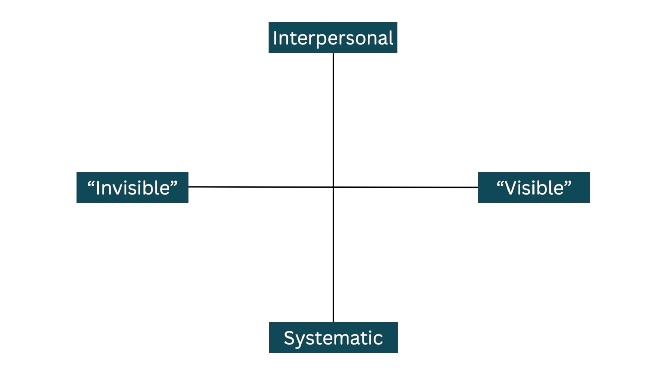
This positioning map is for people to locate the state sexual violence* in the prison industrial complex that the current system is and is not addressing. Each point represents a sexual violence case in Iowa or other state in Midwest, including cases that are not physical, interpersonal incidents.
What is State Sexual Violence?
Here, I define “State Sexual Violence” in two modes:
- Interpersonal sexual assault at prison (e.g. a guard sexually harasses an inmate)
- Systematic sexual violence: the harm underlying in the policies and state interventions in sexual violence (e.g. refusing to provide sexual healthcare for inmates)
This classification appears in Y axis in this map (top: interpersonal, bottom: systematic).
What is "(In)visible" Sexual Violence?
According to the Minnesota Department of Health, there are gaps between availability, access, and tracking of the data about sexual and intimate partner violence. (Minnesota Department of Health, 2024) This means that significant amount of sexual violence cases are not reported or recognized by community members or state officials not only but considerably because of the psychological/financial hurdles that the survivors are facing. Even when survivors report, community members or state officials sometimes do not recognize or intervene the harm because some cases do not align with the stereotypical “victim-offender” models that are based on White-centric, cis-heterosexual view of gender roles.
That being said, I define “(In)visible” of sexual violence as this:
- “Visible”/addressed: State officials/intervention institutions recognize the harm and attempt to intervene in targeted harm.
- “Invisible”/unaddressed: State officials
This classification appears in X axis in this map (right: “visible,” bottom: “invisible”).
Interpersonal sexual violence at prisons
Read the news coverage from Des Moines Register from here.
Case description
On March 8th, 2018, Des Moines Register reported that Kristine Sink, a former prison guard at the Iowa State Penitentiary in Fort Madison, won a two million dollars verdict from a jury as the court found the state and the Iowa Department of Corrections for retailing Sink after her claim about the sexual harrasment from Inmate. Since 2012, as the Des Moines Register writes, Sink had been making a lawsuit claiming that the Penitentiary offcial’s decision to screen “Deranged,” a movie that contains gangrape and torture of women, and refuse to accept her complain, which led the inmates, including those in the clinical care unit, to threat her to beat, rape, and murder her.
State Sexual Violence in this case
First, the selection of film and the decision to screening it that the State Peniteniary official is accountable of is not only ignorant of the psychological harm to female employees at the men’s prison but also to some of the incarcerated individuals at the men’s prison, especially considering the facility includes the medical unit, who had experienced traumatic abuse, physical and sexual. As Sierra’s personal experience shows, incarcerated individuals are oftentimes sexual abuse survivors and gets exposed to revictimization and trauma flashbacks at the carceral institutions, which is enabled and sustained by toxic masculinity pervasive in the gender-specific prisons and also the lack of access to mental healthcare. Kashawn Taylor, a journalist incarcerated in Conneticut, observes the power dynamics among inmates and describes his experience of getting involved into such verbal sexual assault at the prison: He heard and participated in converasations that objectifies women, such as stories of psychological torture and physical violence against women, which Taylor metaphorizes as “an audition where we must out perform each other” to show who is the most “manliest,” where he felt a need to protect himself by engaging with such toxic masculine performances. As Taylor’s article tells, toxic masculinity is pervasive in the prison and harmful not only for workers but for inmates, and the film that shows violent rape of women can easily trigger inmates’ trauma and such competition for the toxic masculinity. Additionally, the initial response from the state Peniteniery official to Sink, attributing all the responsibility for the harm she experienced to herself, disregards the systematic harm in the Peniteniery board members’ film selection process and shows unwillingness to intervene the abuse and prevent potential/on-going-yet-invisible harms at the prison. Sink’s case indicates that the Prison Industrial Complex is not capable of recognizing and address some cases of Sexual Violence, both within and outside of the carceral facilities, when the policy to punish it does not exist.
Why is this case “visible”?
First reason why Sink’s case got both media coverage and a verdict is that Sink’s case fits into the social expectation on the “ideal victim/offerder of sexual violence,” which is built upon whitesupremacist concept of “sexual violence” in the United States. As The Indiana Women’s Prison History Project states that correctional facilities, such as the one organized by a Quaker minister named Sarah Smith, have historically been built upon White Christian, Quaker in Smith’s case, women’s morality of domesticity, which centers the lifestyle White women in a heterosexual marriage whose husbands are rich enough so that they can work in the public sphere by hiring someone who takes care of the domestic. This history of the modern incarceration establishment leads to the current trend for some of the White carceral feminists who centers White women in the sexual violence discourse as the primary subject that “we should protect sexual violence from,” as Davis et al. describes as “rape and the racist manipulation of the rape charge were fundamentally connected.” On the otherhand, as Meiners claims, the process of criminalizing men who assault their intimate partners targets people of color in a lower socioeconomic status, as the criminalization increased number of the incarcerated/deported population of poor men of color instead of a decline in the population of women who are sexually assaulted. Kristine, a White female guard at the men’s prison in Iowa where Black men are overrepresented, checks the boxes of “ideal sexual violence victim” that the White-dominant American society expects and is willing to deal with.
Another major reason for this case fairly getting a spotlight is that the “offender” in this allegation was the inmates. As Dillon argues, carceral systems play a role of punishing people for deviating from racialized, gendered, sexual, and classed social norms, and its system understands the gender and sexuality of women of color as nonnormative, deviant threats to the universalized life of the racial state. This functionality of the carceral institutions individualizes social issues such as poverty, systematic racism, and heteropatriarchal oppression that lie beneath women’s engagement in sexual act, including the non-consensual ones, by attributing it to “personal sexual deviency.” Considering this idea of the state prison, Kristien’s case, although the significance lies in shedding a light on sexual assaults at prison and irresponsibility of the state Peniteniary officials, is convenient for the state carceral system to advocate the necessity of expanding on the state-funded prisons to “demolish such sexual violence” by “punishing the criminal” even more.
Read the news coverage from Des Moines Register from here.
Case Description
On December 20th, 2023, Des Moines Register reported that Plaintiff Justin Mowery, an incarcerated individual, had sued Polk county as the county was negligent of their supervision of the prison guard who sexually assaulted him and threatened when he refused a sexual contact. In 2022, as Morris reports, the prison guard who was accused as an sex offender in Mowery’s lawsuit was pleaded guilty with a prison stay and financial charge. Following up with this lawsuit, however, Morris reported that the lawsuit against the county had been dismissed as Mowery’s claim that the county official being “negligent” is too vague based on the 2021 state law that requires a specific referral for the lawsuit to be regarded as valid.
State Sexual Violence in this case
In Mowery’s case, the State Sexual Violence is located between two individuals, an inmate and a guard, and it contains both a unwanted sexual contact and an emotional abuse/retailation. The State Sexual Violence here, in addition, underlies in the fact that the State could not prevent nor intervene the sexual harm done by guard, who have been trained by the state to “correct” the criminalized behavior. Notably, the Iowa court rejected Mowery’s lawsuit against the state being “neglient” while he won the lawsuit against the individual guard that assaulted him, who eventually got a three-days prison sentence and a fine. The state, similar to Kristien’s case, merely boosts the expansion of the Prison Industrial Complex by creating another criminalized individual, instead of addressing the pitfalls of the education/training system for the employees and implementation of PREA. The state’s reaction to this case neither achieve healing of survivors and responsibility-carriers nor prevention of potential sexual violence between inmates and guards.
Why is this case “visible”?
One of the reason why Mowery’s case got recognition at the court and in the media was that “offender” and “victim” in this case, although it is not aligning with a stereotypical “male offender and female victim” model, still agree with heteropatriarchal notion of masculinity as power, accompanied by violence, and femininity as objectification. In the carceral facilities, incarcerated individuals are subjugated and infantilized with limited access to clothes, books, music, healthcare, and so on, which is parallelized with femininity. This parallelization explains Taylor’s observation on the “toxic masculinity competition” among inmates: Incarcerated individuals are in urgent need to prove their masculinity under the circumstance where they are constantly infantalized by nature of the carceral facilities. On the otherhand, guards and prison officials have domination and supremacy over the incarcerated population with their “responsibility” to correct and punish them, which is parallelized with masculinity, meaning a power in the heteropatriarchal system.
Complexically, Mowery’s case also involves “Invisible State Sexual Violence”: the state did not recognize the state’s systematic violence on Mowert that the neither the state nor the county could not prevent an interpersonal harm at prison. The rationale for the court to reject Mowery’s lawsuit against the Polk county was that he did not have any targeted personnel in particular in his claim and the definition of “neglient” was unclear, which highlights the difficulty to get the state recognize its harm when you do not sue someone in particular, contrasting with Kristien’s winned lawsuit where she had her direct boss and the board member who selected the film. The court was able to recognize and address the interpersonal violence when Mowery’s lawsuit was made: however, the court was not able to recognize or address the systematic harm within the incarceration facilities, organizational power enabling and justifying such interpersonal violence.
Systematic sexual violence
Read the news coverage of this case from here.
Case description
On November 28, 2021, Des Moines Registry reported that Pieper Lewis, a 17-year-old girl at the time who was convicted for first-degree murder, has a personal history typical to sex-trafficking and yet the Des Moines Police Department nor the Polk County Attorney’s Office had not investigated the man Lewis and her attorneys mentioned as her pimp. (Joens, 2021) In the same article, the reporter further describes Lewis’ personal history: Lewis, a Black girl native to Iowa, grew up as a foster child adopted by White parents and stayed in her foster mother’s household until she started to attempt running away in January of 2020 because her foster mother, Leslie Lewis, had been emotionally and mentally abusive towards Lewis, making a racist comment on her appearance and behavior. (Joens, 2021) After moving out of her friend’s house in April 2020 because of an argument, as the reporter follows, Lewis had no choice but to live on the street and got trapped into a 28-year-old man’s house where he forced her to have sex in return for the housing: shortly after that, a 28-year-old man made Lewis stayed at Zachary Brooks who raped her multiple times while she was unconscious, and Lewis stabbed Brooks after she came conscious after she got raped again. (Joens, 2021) As this story indicates, Lewis, as a survivor of domestic violence and sex-trafficking, needed mental health care support throughout her life including the period of probation and incarceration yet the state nor the county had not sufficiently met her medical needs. (Bowman, 2024) Moreover, as the Des Moines Registery reports on May 31, 2023, the state probation officers pushed for moving forward with her incarceration although Lewis said in the interview with the reporter that being trapped in the prison reminds her of her trauma and not working well with her mental health especially under the circumstance where she does not have access to the proper mental health care. (Joens, 2023) In Iowa, as the Des Moines Register reports, there were potentially 551 survivors of sex trafficking at least who were served by the Crime Victim Assistance Division of the Iowa Attorney General’s Office from 2019 to 2020. (Ferkenhoff and Joens, 2021)
State Sexual Violence in this case
One of the harms that the state has caused is not trusting Lewis’s testimony that she faced sex-traffication and rape by the person she murdered, not even investigating the personal information about people who are mentioned in her testimony. Additionally, the state insisted on incarcerating Lewis despite her claim that being locked up, which is similar to her past situation of being in an abusive household and trapped in sex traffication, is not helping her heal. As Silvonek shares her experience of attempting to receive healthcare at the state correctional facility, incarcerated individuals do not have immediate access to the physical/mental healthcare, and even when they receive it, the healthcare they can receive is limited and oftentimes contains misdiagnosis or insufficient treatment. Insisting on incarcerating Lewis in the prison where lacks access to mental healthcare, of which Lewis clearly shows her need in her interview, is another form of harm that the state posed on Lewis: not only the state negates Lewis’ authority in the process of her healing, but also the criminal/correctional sector overlooks the healing for Lewis and other incarcerated people who survived/are surviving sex-traffication by naming it as their “sexual deviency” for the sake of “preventing potential harm to public.”
Why is this case “invisible”?
Before the media started to report on Lewis’ case, the state had not even started investigation in the sex traffication that Lewis was trapped in, which suggests that the major cause for invisiblizing the harm posed on Lewis by the state is epistemic injustice in the process of criminalizing Lewis for murder, specifically police investigation or testimony. Similarly with the harm in Ruchinski’s case, Lewis was also placed in the filtering process for “ideal victim.” The state carceral institution has historically standarized White, middle-class, cis-heteronormative lifestyles as “moral standard,” as Sarah Smith’s story tells, and such standarization merely criminalizes those who are marginalized from the standards. The state seemingly “solves the problem” without addressing the harm that the criminalized individual has experienced, not dismantling the root causes for the surfaced incidents such as poverty, racism, homophobia, transphobia, and patriarchal oppression.
Another rhetoric that the state uses to cover up the systematic harm against the incarcerated population, as seen in Lewis’ case as well, is incarcerating people who committed criminalized acts “to secure public safety.” This notion that incarceration is a requirement to improve public safety reflects a perspective that the person who committed criminalized acts is equal to the problem and thus punishing them at the carceral facilities will resolve “their ” problem. The state, along with carceral feminism as Davis et al. discuss, legitimizes carceral facilities’ use of power to “correct/punish” people from criminalized acts and thus “protect the victims”: this rhetoric attributes the cause of criminal acts thoroughly onto incarcerated individuals, which turn public attention away from the carceral facilities’ inability to prevent nor intervene potential harm as the state is not deconstructing the core institutions that reproduces similar criminalized acts such as sex-traffication or poverty. (Davis et al. 2022)
Read the news coverage of this case from here.
Case description
On December 22, 2019, Des Moines Registry reported the story of Justina Ruchinski at the courtroom testifying a convicted case as a rape survivor, where Steven Mauck was convitcted for the sexual assault in the second degree. The report describes that the testimony process includes asking Ruchinski her final educational degree, marriage status, parental status, and the age of her children at the first and, as the process goes further, if she was wearing underwear and the type of underwear along with uncountable open questions about the situation.
State Sexual Violence in this case
While the state recognizes Ruchinski’s case as a rape and sentenced the offender with prison sentence, this juridical system at the Iowa supreme court does not consider the systematic harm that lies in its juridical process that revictimizes Ruchinski by essentializing publically recounting the day when she was raped in order to give the authorization to her testimony. Moreover, as the reported set of questions in the beginning of the testimony indicates, Ruchinski is subjugated to the screening process to confirm whether a testified individual qualifies as an “ideal victim” and thus is trustworthy.
Why is this case “invisible”?
One of the reason why the systematic emotional harm on Ruchinski is not recognized by the state official despite of the media’s attention is, in line with how Mowery’s lawsuit against the county remained overlooked, because exercise of the patriarchal power, sometimes accompanied with (sexual and emotional) violence, is embedded and legitimized in the state’s juridical sector along with the criminal/correctional sector. As The Indiana Women’s Prison History Project describes a correctional organization in “Sally and the Women and Girls at the Reformatory,” social reformers and prison officials are historically known to equip violence to reinforce the specific value in institutions of power, where such violence is legetimized. One of the examples of such exercise of the power followed by sexual violence is strip-frisk. Arthur describes his experience of being strip-frisked inside of the correctional facility: the guards shouted at inmates ordering them to take off their clothes and bend over to show their butthole, and inmates, as Mowery had experienced, would be pinned down on the ground or the wall, ripped off of their clothes, and anally probed if necessary when they refused to submission, which Arthur points out its similarities to the statutes of sexual assault and rape. As Arthur’s argument indicates, incarceration facilities create heteropatriarchal hierarchy among guards and inmates regardless of their gender and enable and legitimize interpersonal emotional/sexual/physical violence as a tool of correction and punishment. This juridical system, which essentializes publicly speaking on the personal experience of being sexually assaulted for the survivors to attribute accountability to them, prioritizes criminalization and punishment on offenders rather than preventing revictimization and the harm of trauma and healing of survivors and offenders. Emotional harm evoked by the juridical testimony is disregarded because such harm is considered as a necessary evil for the sake of punishment and prevention of potential sexual violence.
This testimony process, moreover, functions as a filter to sort out “ideal, accountable victim” from “non-accountable victim” who will track the path of criminalziation or medicalization. As some of the questions asked to Ruchinski shows, the juridical procedure directly screens one’s educational status, marriage status, parental status, medical history, and criminal history, which indirectly examines one’s socio-economic status, drug usage, gender identity, sexuality, and mental or physical disability. Accountability in the state legal sector, similar to Richie’s argument on deservingness, standarizes White, middle-class, cis-heteronormative social status and filters out other populations, mainly POC, low-income, and/or performing non-normative gender/sexuality by regarding them the status of “deserving victim.”
Huge appreciation to people who helped me through the creation to this website: Dr. Clara Montague, Elizabeth (Libby) Cave, MAP team members (Agatha, Cadance, and Sage), and Dr. Sameena Mulla.
Minnesota Department of Health. (2024, March 8). Sexual Violence and Intimate Partner Violence Data. https://www.health.state.mn.us/communities/svp/data/index.html.
Richie, Beth E. Feminist Response to Male Violence. New York University Press, 2012. https://doi.org/10.18574/nyu/9780814723913.003.0008.
Davis, Angela Y., Gina Dent, Erica R. Meiners, and Beth E. Richie. (2022). “feminism.” In Abolition. Feminism. Now. Haymarket Books.
Gruber-Miller, Stephen. “Former Iowa prison guard wins $2 million verdict in retaliation lawsuit.” Des Moines Register (Des Moines, IA), March 8, 2018. https://www.desmoinesregister.com/story/news/crime-and-courts/2018/03/08/former-iowa-prison-guard-wins-2-million-verdict-retaliation-lawsuit/406704002/.
Basu, Rekha. “Why did prison give inmates access to filthy trash?.” Des Moines Register (Des Moines, IA), September 25, 2014. https://www.desmoinesregister.com/story/opinion/columnists/rekha-basu/2014/09/26/let-inmates-see-filthy-trash/16246709/.
Sierra, Peter. “Toxic Masculinity Led to My Life of Crime.” Prison Journalism Project (Berkeley, CA), October 11, 2021. https://prisonjournalismproject.org/2021/10/11/toxic-masculinity-led-to-my-life-of-crime/.
Taylor, Kashawn. “How Prison Takes Toxic Masculinity to New Levels.” Prison Journalism Project (Berkeley, CA), August 27, 2023. https://prisonjournalismproject.org/2023/08/27/prison-takes-toxic-masculinity-to-outlandish-levels/.
The Indiana Women’s Prison History Project. (2023). Who Would Believe A Prisoner?. New York: The New Press. Edited by Michelle Daniel Jones and Elizabeth Nelson.
Meiners, Erica R. “Never Innocent: Feminist Trouble with Sex Offender Registries and Protection in a Prison Nation.” Meridians: Feminism, Race, Transnationalism 9, no. 2 (Spring 2009): 31-62,153.
Dillon, Stephen. Fugitive Life: The Queer Politics of the Prison State. Duke University Press, 2018. https://doi.org/10.1515/9780822371892.
Morris, William. “Polk County, sheriff sued over sexual assault.” Des Moines Register (Des Moines. IA), December 20, 2023. https://www-proquest-com.grinnell.idm.oclc.org/docview/2903766970/C284A72681C24A11PQ/10?accountid=7379&sourcetype=Newspapers.
Morris, William. “Polk County not responsible for actions of guard who sexually abused inmate, judge rules.” Des Moines Register (Des Moines. IA), June 27, 2024. https://www.desmoinesregister.com/story/news/crime-and-courts/2024/06/27/polk-county-iowa-jail-sex-abuse-lawsuit-dismissed/74220331007/?itm_campaign=confirmation&itm_content=news&itm_medium=onsite&itm_source=onsite.
Iowa Division of Criminal Investigation. “Iowa Sex Offender Registry.” Accessed on July 29. https://www.iowasexoffender.gov/.
America Counts Staff, “Iowa’s 2020 Population Neared 3.2 Million in 2020,” United States Census Bureau, August 25, 2021, Accessed on July 29, 2024. https://www.census.gov/library/stories/state-by-state/iowa-population-change-between-census-decade.html.
Crowder, Courtney. “This is what it is like to testify against your rapist: Pain from trial adds to horror of sexual assault.” Des Moines Register, (Des Moines, IA). December 22, 2019. https://www-proquest-com.grinnell.idm.oclc.org/docview/2329506265/C315093C21ED4704PQ/5?accountid=7379&sourcetype=Newspapers.
Arthur, Corey Devon. “I’ve Been Strip-Frisked Over 1,000 Times in Prison. I consider It Sexual Assault.” The Marshall Project (New York, NY), February 4, 2021. https://www.themarshallproject.org/2021/02/04/i-ve-been-strip-frisked-over-1-000-times-in-prison-i-consider-it-sexual-assault.
Joens, Philip. “Lawyers contend that teen who killed her alleged rapist is also a victim: Her case is a classic example of sex trafficking, experts say, but court records show no investigation of that.” Des Moines Register (Des Moines, IA), November 28, 2021. https://www-proquest-com.grinnell.idm.oclc.org/docview/2603351966/C315093C21ED4704PQ/6?accountid=7379&sourcetype=Newspapers.
Bowman, Beau. “Pieper Lewis sought for another probation violation.” KCCI Des Moines (Des Moines, IA), May 10, 2024. https://www.kcci.com/article/pieper-lewis-iowa-sought-for-another-probation-violation/60757212.
Philips Joens, “Pieper Lewis gets 20-year sentence, but then is placed on probation again,” Des Moines Register (Des Moines, IA), May 31, 2023. https://www.desmoinesregister.com/story/news/crime-and-courts/2023/05/31/des-moines-sex-trafficking-victim-pieper-lewis-in-court-after-escape-probation/70268567007/.
Ferkenhoff, Eric and Philip Joens. “Report: Most states, including Iowa, treat young people ensnared by sex trafficking as criminals rather than victims.” Des Moines Register (Des Moines, IA), November 29, 2021. https://www.desmoinesregister.com/story/news/crime-and-courts/2021/11/28/child-sex-trafficking-report-cards-shared-hope-international-states-fail-to-protect-children-iowa/8410329002/.
Silvonek, Jamie. “As a Girl in Prison, I Experienced Degrading Health Care.” Prison Journalism Project (Berkeley, CA), February 11, 2024. https://prisonjournalismproject.org/2024/02/11/womens-health-care-in-prison-is-degrading/.